Bootcut or Leggings for a Long Travel Day? The Honest Comparison
Quick Answer: Leggings win on comfort in the seat and lose everywhere else - temperature regulation, arriving somewhere presentable, and how they feel by hour ten. Bootcut in a soft ponte wins on airflow around the lower leg, looking put-together on arrival, and layering over the ankle. For a flight under four hours, leggings. For anything longer, or anything where you go straight somewhere on arrival, bootcut.
Both are comfortable at hour one. The comparison only gets interesting at hour eight.
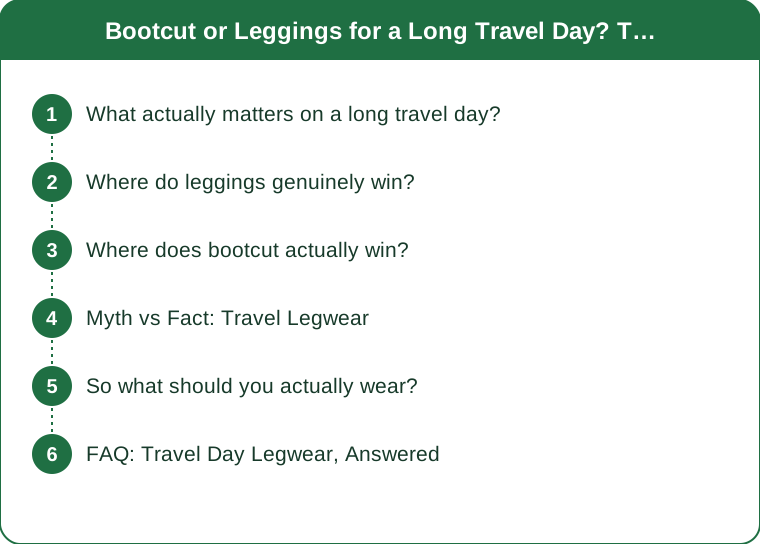
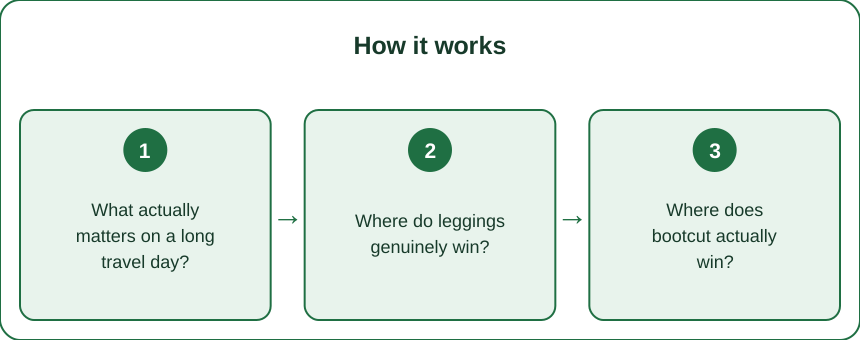
What actually matters on a long travel day?
Five things, and comfort in the first hour isn’t the one that decides it.
Temperature swing. A travel day routinely covers a warm car, an over-air-conditioned terminal, a cold cabin at cruising altitude, and a warm arrival. You will be too hot and too cold on the same day, and legwear that only works at one temperature is a problem for most of the journey.
Swelling. Lower leg and ankle swelling on long flights is well documented - reduced movement plus cabin pressure plus sitting. Anything with a tight cuff around the calf or ankle becomes noticeably uncomfortable by hour six in a way it wasn’t at hour one.
Waistband over hours. A waistband that’s fine standing can be genuinely uncomfortable after eight hours seated, particularly after eating.
Getting through security and moving around. Removing shoes, standing, walking terminals, and lifting a bag overhead all favour something that moves.
Arriving presentable. If you’re going straight to a hotel, this doesn’t matter. If you’re going to a meeting, a dinner, or someone’s house, it matters a lot - and it’s the criterion people most reliably forget when they get dressed at 5am.
Where do leggings genuinely win?
Three clear advantages, all real.
Seat comfort in the first hours. No waistband digging, no fabric bunching behind the knee, complete freedom to fold up in a seat. For a short flight this is decisive and nothing else beats it.
Packability and versatility on the ground. A pair of black leggings works for a walk, a hotel gym, a lie-down, and a casual dinner. As a single item covering multiple functions on a trip, they’re hard to beat, which is a packing argument as much as a travel-day one.
Layering under. They fit under a longer dress, under trousers in genuinely cold weather, and under anything without adding bulk.
And where they specifically lose:
- Airflow. A full-length compressive fabric against the entire leg is warm, and there’s no way to vent it. On a warm terminal walk with a heavy bag, this is the moment people regret them.
- Ankle and calf pressure. A snug leg becomes noticeably less comfortable as legs swell, which is precisely the second half of a long flight.
- Arrival presentability. Leggings look like leggings. Under a long coat and boots they pass in most contexts; on their own in a well-lit arrivals hall after twelve hours, less so.
- Bathroom and layering logistics. Removing and replacing a compressive layer in an aircraft toilet is genuinely awkward, and this is the specific complaint on the longest flights.
Where does bootcut actually win?
Four advantages, and two of them only appear late in the day.
Airflow around the lower leg. The flare means the fabric isn’t in contact with your calf and ankle, which does two things: it vents heat, and it accommodates swelling without any change in comfort. This is the single biggest late-flight advantage and it’s invisible when you’re choosing at 5am.
Arrival presentability. A ponte or wool-blend bootcut with a knit top reads as an outfit. You can go from a plane to a dinner without changing, which on a short trip can eliminate an entire outfit from your bag.
Sock and boot layering. The flare goes over a boot shaft and over thick socks. Arriving somewhere considerably colder than you left is much easier to handle when you can add layers under the trouser hem rather than only over the top.
Waistband options. Bootcut in a travel fabric frequently comes with a flat, wide, non-elastic-feeling waistband that sits comfortably over hours, or a pull-on version with a flat front panel that gets you legging comfort with trouser appearance.
Where bootcut loses:
- Fabric on the floor. In airport bathrooms and while walking through rain, a longer hem picks things up. This is a genuine and unglamorous downside.
- Bulk in a seat. More fabric around the lower leg means more to arrange when curling up.
- Getting the length right. A bootcut hemmed for heels is a liability in flat travel shoes, dragging and catching.
Myth vs Fact: Travel Legwear
Myth: Compression leggings prevent swelling on flights. Fact: Proper graduated medical compression stockings are the garment studied for circulation on long flights, and they’re a specific product with a specific pressure gradient. Ordinary compressive activewear leggings are not the same thing and shouldn’t be assumed to do the same job. If circulation on flights is a genuine concern for you, that’s a conversation with a doctor - this is general information, not medical advice.
Myth: Airlines care what you wear. Fact: Contracts of carriage address offensive or inadequate clothing in broad terms, and the situations that make the news are rare and specific. Both leggings and bootcut trousers are entirely unremarkable in any cabin.
Myth: You should always dress up in case of an upgrade. Fact: Modern upgrades are allocated by status, fare class, and system rules, not by appearance. Dress for twelve hours of comfort.
Myth: Jeans are the worst travel option. Fact: Rigid denim is genuinely uncomfortable at hour eight. Stretch denim in a relaxed cut is perfectly reasonable, and the blanket rule is more folklore than finding.
Myth: Whatever’s comfortable at home is comfortable on a plane. Fact: Sitting still for hours at altitude with mild swelling is a different physical situation from sitting on your sofa. Anything with a tight ring around a limb performs worse than it does at home, which is why the ankle-cuff detail matters so much more than it seems like it should.
So what should you actually wear?
By trip type, with the reasoning.
Under four hours, nothing on arrival: leggings. Seat comfort dominates on a short flight and none of the late-flight downsides have time to appear.
Four to eight hours: bootcut in a soft ponte or travel knit. This is the range where swelling and heat start to matter and presentability may still be relevant. The airflow around the lower leg is the deciding factor.
Eight hours plus: bootcut, with a strong preference for a flat wide waistband and a mid-weight fabric. On the longest flights, the pressure-free lower leg is worth more than any other single comfort feature.
Going straight to something on arrival: bootcut, with a knit top and a blazer or long cardigan in the bag. Changing in an airport bathroom after twelve hours is worse than dressing for it at the start.
Cold arrival, warm departure: bootcut, because you can add thermal layers or thick socks underneath at the destination without changing.
Multi-leg journey with a long layover: bootcut. You’ll be walking, sitting in terminals, and possibly eating a real meal, and it handles all three.
Whichever you choose, the details that matter more than the category:
- Fabric in a mid-weight matte knit, not thin and not compressive
- A flat waistband that isn’t a narrow elastic band
- A layer you can remove, since the cabin will be colder than the terminal
- Compression socks if you’re on a long flight and want the circulation benefit - the actual graduated kind, worn under whatever you’ve chosen
- Shoes that come off and on easily and that you can walk a terminal in
FAQ: Travel Day Legwear, Answered
Are leggings really fine to fly in?
Entirely, on any normal airline. The occasional story about a passenger being challenged involved specific circumstances that don’t apply to ordinary paying passengers.
Should I wear compression socks with either?
If circulation on long flights is a concern for you, graduated compression socks are the studied option and go under either choice. Worth discussing with a doctor rather than self-prescribing.
What about a dress or a skirt?
Comfortable and warm-adaptable with tights, but awkward in a seat and cold at altitude. Plenty of people travel this way happily; it’s mostly a question of what you’re doing on arrival.
Does the fabric matter more than the cut?
Often yes. A thin compressive bootcut and a mid-weight matte legging behave more like each other than either behaves like its category stereotype. Mid-weight and matte is the through-line for both.
TL;DR:
- Under four hours, leggings - seat comfort dominates and the downsides don’t have time to appear
- Over four hours, bootcut - airflow around the lower leg handles heat and swelling
- Any tight ring around calf or ankle gets noticeably worse from hour six onward
- Bootcut lets you layer socks and thermals under the hem for a colder arrival
- Mid-weight matte fabric and a flat wide waistband matter more than which cut you pick
Both are fine at hour one. Dress for hour ten.
See It in Motion
Seen here: Bootcut Yoga Pants with Side Pockets — shop it on bubblelime.com
Keep Reading
This article is for general informational and styling purposes only. Fit, sizing, and product availability may vary.
