Bootcut or Legging for Your Workout? The Honest Breakdown
Quick Answer: Bootcut works for low-impact, steady movement — walking, barre, Pilates, yoga flow — where the flared hem doesn’t catch on anything. Leggings win for anything with fast direction changes, jumping, or machines with moving parts, where loose fabric is a real hazard.
The bootcut comeback is real, and it looks great. But ‘looks great’ and ‘safe for burpees’ are two different questions, and the fitness content pushing bootcut for every workout skips the second one.

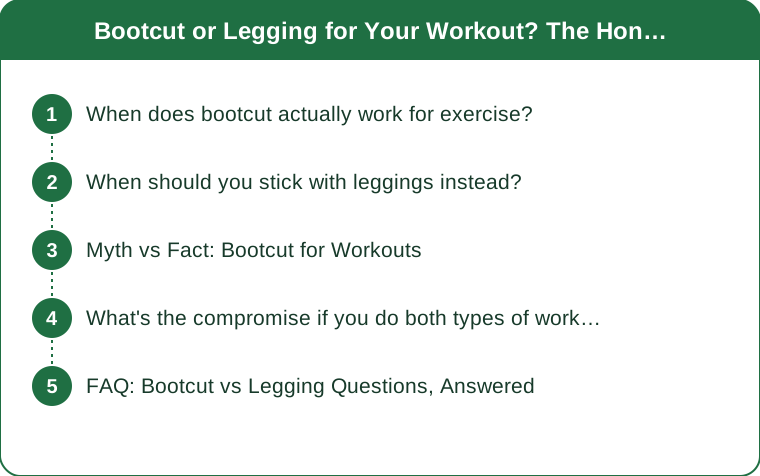
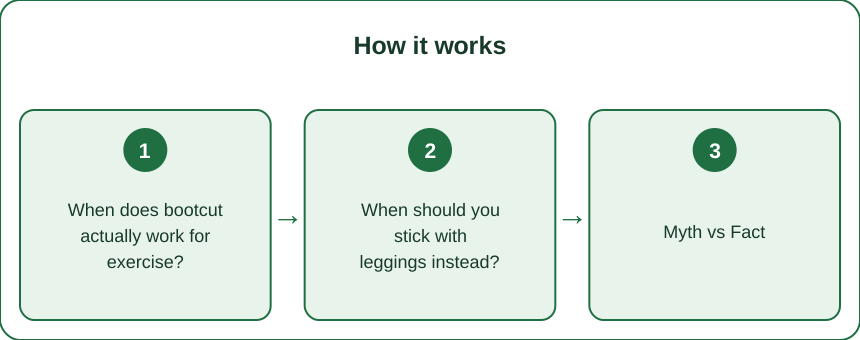
When does bootcut actually work for exercise?
Anytime your feet stay roughly under you and movement is controlled: walking, incline treadmill, barre, Pilates reformer, gentle yoga, strength training with dumbbells. The flare sits low enough on the calf that it doesn’t interfere, and the fitted thigh still gives you range of motion.
It also genuinely elongates the leg line more than a legging does — if the workout is aesthetic-forward (a studio class you’re also photographing), that’s a real point in bootcut’s favor.
When should you stick with leggings instead?
Anything with fast footwork, jumping, or moving machine parts: HIIT, plyometrics, spin class, rowing machines, cable stations, or gym floors with a lot of equipment to catch fabric on.
The flared hem can catch a heel mid-jump-squat or snag on a spin pedal — minor annoyance at best, a trip hazard at worst. If your workout involves explosive movement, leggings aren’t just more practical, they’re safer.

Myth vs Fact: Bootcut for Workouts
Myth: Bootcut is only for lounging, not real workouts. Fact: Technical bootcut leggings (moisture-wicking, four-way stretch) perform identically to straight leggings for anything low-impact — the flare is cosmetic below the knee, not functional.
Myth: The flare makes your legs look shorter. Fact: The opposite — a well-placed flare that hits right above the ankle bone visually extends the leg line more than a skinny-fit legging does.
Myth: You need to size up in bootcut for comfort. Fact: Bootcut should fit the thigh and knee exactly like your regular legging size — the flare is added fabric below the knee, not overall room.
What’s the compromise if you do both types of workout in one session?
A cropped bootcut (hits mid-calf) gives you most of the flattering flare with almost none of the catch risk, since there’s less fabric swinging below the knee. It’s the practical middle ground for a class that mixes standing strength work with a few minutes of faster cardio.
Or keep both in your bag: bootcut for the warmup and cooldown walk, legging change for the interval block. Not glamorous, but it works.
FAQ: Bootcut vs Legging Questions, Answered
Are bootcut leggings less compressive than regular leggings?
Usually not through the thigh and hip — the compression panel is identical. Only the fabric below the knee changes shape.
Can you wear bootcut for running?
Short, slow runs on a clear path, sure. Trail running or speed work, no — the flare adds drag and catch risk you don’t want at pace.
Do bootcut leggings work for petite frames?
Yes, often better than straight-leg — the flare balances proportions. Look for a shorter rise-to-flare ratio so the flare doesn’t start too high and overwhelm a shorter leg.
TL;DR:
- Bootcut: walking, barre, Pilates, yoga — controlled movement, no catch risk
- Leggings: HIIT, plyo, spin, machines — anything fast or equipment-heavy
- The flare is cosmetic below the knee; thigh fit and compression stay the same
- Cropped bootcut is the practical middle ground for mixed-format classes
Pick by movement pattern, not by trend — then you get the look without the tripping hazard.
See It in Motion
Seen here: High Waist Yoga Leggings with Inner Pocket — shop it on bubblelime.com
Keep Reading
This article is for general informational and styling purposes only. Fit, sizing, and product availability may vary.
