Bootcut vs Leggings, Workout by Workout: Which Actually Wins Where
Quick Answer: Leggings win anywhere your feet move fast or machinery is involved - running, cycling, HIIT, trail work - because a loose hem near pedals, belts, and your own footstrike is a genuine liability. Bootcut wins the slow, grounded rooms: yoga, mat pilates, barre, lifting days built around squats and hinges, and any workout that flows into errands afterward. The tiebreaker is almost always the hem: ask what your feet and the floor are doing, and the answer picks your pants.
This debate gets argued as fashion - comeback silhouette versus the default decade. On the gym floor it is not fashion at all. It is a hem-engineering question with a different correct answer depending on what the next hour contains, and once you see the pattern, the closet decision takes four seconds.
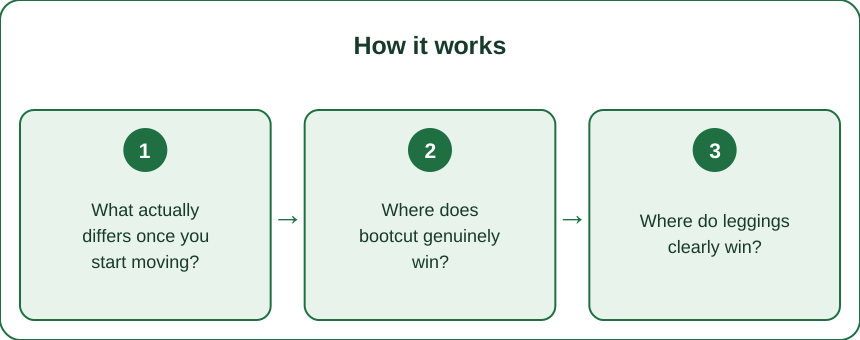
What actually differs once you start moving?
Three mechanical differences drive every verdict below.
The hem and your feet. Leggings end in a cuff that grips the ankle and disappears from the movement equation. A bootcut hem is architecture: it swings, drapes over the shoe, and occupies the couple of inches of airspace around your feet. In slow grounded movement that airspace is free; in fast footwork it is occupied by your own footstrike, a treadmill belt, or a pedal.
Visibility of the leg. Leggings show your knee and ankle alignment to an instructor or a mirror; bootcut hides the shin and ankle. This matters more than people expect in form-heavy settings - and matters zero on a recovery walk.
Air and after. The flare moves air with every step, which reads as comfort in warm studios and long wears, and it converts to street clothes instantly - the whole reason bootcut yoga pants became the errand uniform. Leggings run warmer and read as gym kit, which is either fine or not depending on where the day goes next.
Fabric quality is the shared prerequisite rather than a difference: whichever silhouette you pick, squat-proof opacity and a waistband that survives bending are non-negotiable. A buttery-soft fabric that fails the daylight bend test fails in both shapes equally.
Where does bootcut genuinely win?
Yoga - most of it. Slow flow, hatha, yin, restorative: bootcut is in its home country. The flare follows long holds gracefully, breathes in warm rooms, and nobody needs your ankle visible in a supported bridge. The exceptions are hot yoga - soaked flare fabric clings and weighs - and inversion-heavy practice, where fabric obeying gravity toward your face argues for a cuffed ankle.
Mat pilates and barre. Grounded, controlled, mostly barefoot or grip-socked: the hem faces no hazards, and the line looks intentional at the barre. Only fast relevé footwork sequences occasionally argue for 7/8 leggings instead.
Lifting - the quiet surprise. Squats, hinges, presses: bootcut performs beautifully. The flare clears squat depth without the mid-thigh compression shifting, and the straight drape looks composed between sets. The single asterisk is conventional deadlifts, where the bar travels close against the shin and a draping hem is in its path - leggings genuinely serve the bar path better on heavy pull days.
Walking workouts and the errand-blend day. For the walk that becomes a coffee that becomes a grocery run, bootcut yoga pants are the entire value proposition: one garment, no outfit change, looks deliberate everywhere. This category quietly covers more real hours than any gym room does, which is why the silhouette earned its comeback.
Where do leggings clearly win?
Running, always. A swinging hem at footstrike is friction, noise, and in wet weather a soaked mop at the ankle - and on a treadmill, fabric near a moving belt is a hard no. Cuffed leggings or shorts end the discussion before it starts.
Cycling and spin, absolutely always. Wide hems and drivetrains are enemies from different centuries. Chainrings, crank arms, and clip pedals all want to eat loose fabric; every cyclist eventually learns why the right ankle of jeans gets rolled. Leggings only.
HIIT, plyometrics, and agility work. Burpees, box steps, jump rope, lateral shuffles: fast feet plus floor contact plus equipment underfoot means the hem’s airspace is constantly occupied. Leggings also give you the ankle visibility to catch your own knee caving on landings.
Hot and soaked sessions. Hot yoga, sweat-heavy conditioning, rainy outdoor anything: saturated flare fabric turns heavy and clingy, while a fitted legging carries sweat without changing its behavior.
Anything with a machine near your feet - rowing ergs with their sliding rail, stair climbers, ellipticals with close pedal housings. The rule generalizes cleanly: moving parts near the ankle means fitted at the ankle. When you cannot decide, ask whether anything in the next hour - including your own feet - moves fast within a foot of the floor. Yes means leggings. No means preference rules, and bootcut usually takes it on comfort and looks.
Myth vs Fact: The Bootcut Comeback
Myth: Bootcut is just a fashion revival with no athletic function. Fact: The flare has real functional properties - airflow, unrestricted depth in squats and lunges, shoe coverage - which is why it never left yoga and pilates studios even during peak legging monoculture.
Myth: Leggings are universally more flattering. Fact: Silhouettes are tools, not rankings. The flare balances hips and lengthens the leg line over a shoe in ways leggings do not attempt; leggings show the leg’s actual line. Different effects, both deliberate.
Myth: You cannot lift heavy in bootcut. Fact: Squats, presses, lunges, and hinges work fine in a well-cut pair - the only honest asterisk is the deadlift bar path. Plenty of strong sessions happen in bootcut yoga pants every day.
Myth: Bootcut means overheating. Fact: The flare vents more air than a fitted ankle. The overheating story belongs to soaked fabric in hot rooms, which is a moisture problem, not a temperature one.
Myth: You must pick a side. Fact: The workout picks. A drawer with two or three of each, assigned by the hem rule, outperforms loyalty to either silhouette every week of the year.
FAQ: Bootcut vs Leggings Questions, Answered
Are bootcut yoga pants good for actual workouts?
Genuinely good for yoga, pilates, barre, most lifting, and walking - the slow, grounded categories. They are the wrong tool for running, cycling, and jump-heavy conditioning, where a fitted ankle earns its keep.
Why do cyclists and runners avoid flared hems?
Because the hem occupies the airspace where their equipment and footstrike live. Chains and crank arms catch fabric; footstrike friction and treadmill belts punish swing. It is mechanics, not style.
Which is better for hot yoga?
Leggings or shorts. Saturated flare fabric goes heavy and clingy within twenty minutes; fitted styles carry the sweat without changing behavior.
Can bootcut work for gym-to-street days?
It is the category champion for exactly that - train legs, run errands, meet a friend, one outfit. If most of your workouts blend into life, that convenience is a legitimate reason to default bootcut and keep leggings for the fast-feet days.
TL;DR:
- The hem decides: fast feet, belts, or pedals near the ankle means leggings; slow grounded floors mean bootcut is fair game.
- Bootcut wins yoga, pilates, barre, most lifting, and every workout that flows into errands.
- Leggings win running, cycling, HIIT, hot rooms, and machine cardio - no exceptions on the bike.
- Both silhouettes share one prerequisite: opaque, bend-proof fabric. Shape never rescues sheerness.
Stop asking which side of the debate you are on and start asking what your feet are doing for the next hour. The workout picks the pants - and a drawer that owns both answers is the one that never gets it wrong.
See It in Motion
Seen here: Bootcut Capri Yoga Pants with Pockets — shop similar styles on bubblelime.com
Keep Reading
This article is for general informational and styling purposes only. Fit, sizing, and product availability may vary.
